How to Apply Minoxidil Correctly: A Step-by-Step Guide
Solution and foam technique, dry vs wet hair, drying time, styling, washing and the small habits that decide whether you get consistent results.
FOLIGAIN® Editorial Team · 18 min read · Updated 2026-09-28
Medical facts and treatment details have not been independently medically reviewed.
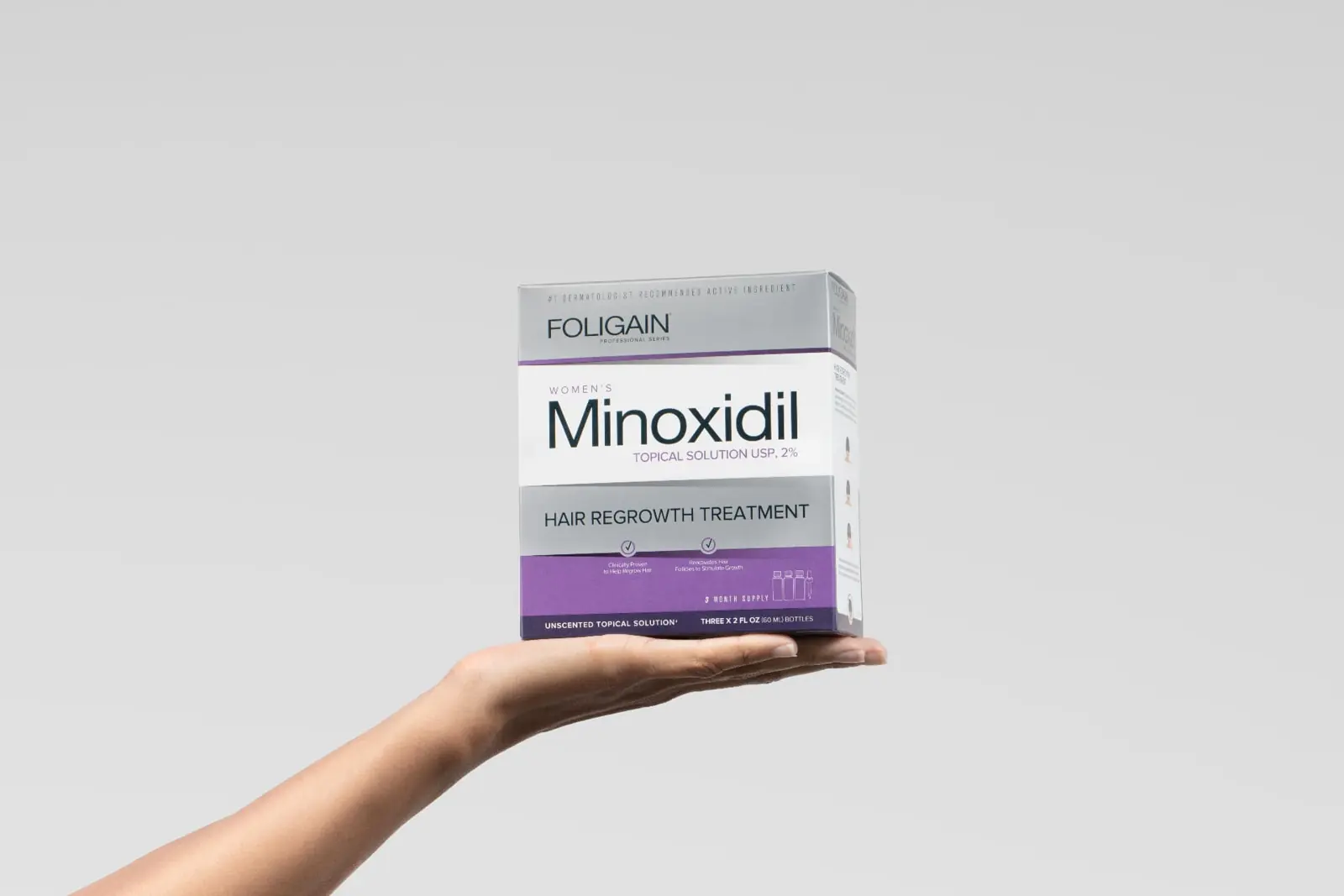
Before you start
Read the Drug Facts label of your specific product. It states who it's for, the amount, how often and the warnings. Check that your scalp is healthy: don't apply to sunburned, broken or inflamed skin.
Pick a consistent time. Most people link applications to existing habits, such as after brushing teeth in the morning and at night. Linking the habit to something you already do daily is one of the most reliable ways to avoid missed doses, since Minoxidil's benefit depends on regular, sustained use rather than any single application.
It also helps to confirm, before you start, that pattern hair loss is actually what you're dealing with. Minoxidil is labeled for hereditary thinning — a receding hairline or crown thinning in men, or diffuse thinning and a widening part in women — that develops gradually over months or years. If your shedding started suddenly, came with scalp pain, redness, scaling or patchy bald spots, or followed an illness, medication change or major stressor, applying Minoxidil correctly won't address the underlying cause. A dermatologist visit before you begin can save months of applying a product to the wrong problem.
Applying a solution (dropper or spray)
Solutions spread well and reach the scalp easily through longer hair.
- Make sure scalp and hair are dry, or towel-dried if your label allows
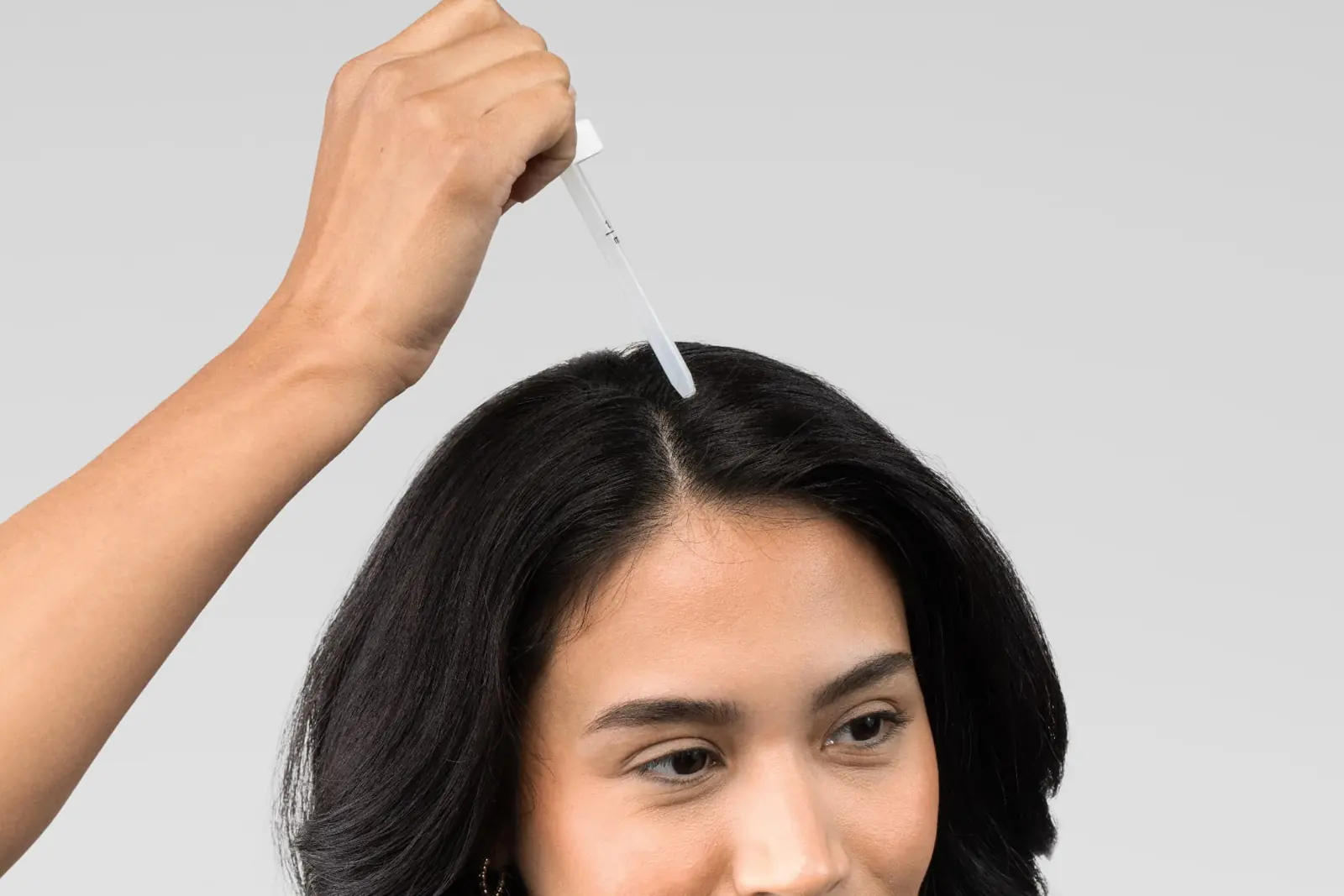
- Part the hair in the thinning area to expose the scalp
- Fill the dropper to the 1 mL line (or use the labeled number of sprays)
- Apply in small amounts along several parts across the area
- Gently spread with fingertips; don't rub vigorously
- Wash hands thoroughly
- Allow to dry before lying down, wearing a hat or styling
Applying a foam
Foam melts at body temperature, so dispensing it onto warm fingertips makes it disappear before it reaches your scalp. Rinse your hands under cold water and dry them first, or dispense into the cap, then massage the foam directly onto the scalp in the thinning area.
Foam formulations were partly developed to avoid propylene glycol, an ingredient in many solutions that some people find drying or irritating. If a solution has bothered your scalp in the past, a foam labeled for your sex and needs may be worth discussing with a pharmacist — but switching formats doesn't change the underlying active ingredient dose you should be using, so stick to the labeled amount for whichever product you choose.
Timing: drying, washing and styling
These are general norms from product labeling and common practice; your label takes priority.
| Question | Practical guidance |
|---|---|
| How long to dry? | Usually 20–30 minutes until dry to the touch |
| When can I wash my hair? | Ideally about 4 hours after application |
| Can I use gel or spray? | Yes, once the product is dry |
| Swimming or rain? | Aim for at least 4 hours of contact first |
| Before bed? | Allow drying time to limit transfer to the pillow |
Building a routine that survives real life
The biggest obstacle to good Minoxidil results usually isn't technique — it's simply not applying it often enough, for long enough. Because Minoxidil works on the hair growth cycle, missed applications don't just delay results marginally; inconsistent use across months can mean you never reach the point where a fair assessment is even possible.
Practical strategies help: keep the bottle or foam can somewhere you'll see it at the times you've chosen, such as next to your toothbrush or on your nightstand. Some people set a phone reminder for the first few weeks until the habit sticks. If travel, shift work or a busy schedule make twice-daily application unrealistic, ask a pharmacist about a once-daily labeled option rather than abandoning treatment altogether.
It's also worth deciding in advance how you'll track your own consistency — a simple checkmark on a calendar or a note in your phone can help you honestly answer, months later, whether you actually gave the product a fair trial before judging whether it worked.
Tracking results as you apply
Good application technique matters, but so does knowing what you're looking for and when. Take a baseline photo before you start, in consistent lighting, with dry, similarly styled hair, from the same angle you'll use in follow-up photos. Repeat monthly rather than checking daily in the mirror, since day-to-day differences in lighting, styling and hair length make short-term comparisons unreliable.
Most US Drug Facts labels suggest a four-month checkpoint as a reasonable point to assess whether the product is working for you, with some clinicians suggesting waiting up to six months for a fuller picture. Early shedding in the first two to eight weeks is common and doesn't mean the technique is wrong or that the product has failed — it often reflects follicles cycling into a new growth phase.
Common mistakes
Most disappointing results trace back to a handful of avoidable habits.
- Applying to the hair rather than the scalp
- Using more than the labeled amount hoping for faster results
- Skipping days, then doubling up
- Stopping during the early shedding phase
- Judging results before 4 months
- Applying to the whole head when only one area is thinning (more product, more irritation risk, no extra benefit)
Combining Minoxidil with other hair-care steps
Many people also use shampoos, conditioners or scalp serums alongside topical Minoxidil. FOLIGAIN® makes cosmetic hair-care products, including some containing TRIOXIDIL®, a FOLIGAIN® cosmetic ingredient complex. These are cosmetic products, not OTC drugs, and they are not a substitute for the Minoxidil itself if that's the treatment you and your clinician have chosen — they're a separate part of a routine, not a replacement step.
If you do layer other scalp products into your routine, apply Minoxidil first and let it dry completely before applying anything else, unless your label instructs otherwise, so you don't dilute the dose or interfere with absorption. Avoid switching several products at once, since it becomes harder to tell what's helping or irritating your scalp if you change more than one variable at a time.
Special situations: long hair, beards and sensitive scalps
People with long or thick hair sometimes struggle to get solution or foam onto the scalp rather than the hair shaft. Parting the hair into multiple small sections across the thinning area, rather than trying to cover it in one or two large partings, usually gives more even scalp contact and uses the labeled amount more efficiently. A rattail comb or the pointed end of a comb can help create clean, narrow partings quickly.
For sensitive scalps, patch-testing a new product on a small area for a few days before full use can flag irritation early, though this isn't a formal requirement of every label — check your specific product's instructions. If your scalp has a history of eczema, psoriasis or other inflammatory conditions, discuss timing and formulation with a dermatologist before starting, since these conditions can make irritation more likely or harder to distinguish from a Minoxidil reaction.
Beard or facial hair use is a different topic entirely: Minoxidil products sold for scalp application are not labeled for facial hair growth, and using a scalp product on the face is off-label. If facial hair growth is your goal, that's a separate conversation with a clinician, not a variation on the scalp technique described here.
When technique isn't the problem
If you're applying correctly, consistently and for long enough, but still see no change after four to six months, the issue usually isn't technique. At that point it's worth revisiting whether pattern hair loss is really the correct diagnosis, whether the labeled strength and format are right for you, or whether an underlying condition (thyroid issues, iron deficiency, a medication side effect, or a scalp condition) is limiting your response.
It's easy to keep tweaking the routine — trying a different time of day, a different amount, a different product — when the real issue is that more time, a different treatment altogether, or a clinical evaluation is what's needed. Bring your application history and photos to that conversation so a clinician has a clear picture of what you've actually tried.
Traveling and adjusting your routine without breaking it
Travel, time-zone changes and disrupted schedules are among the most common reasons people fall out of a Minoxidil routine. Packing enough product for the trip, keeping it in carry-on luggage in case of checked-bag delays, and anchoring application to a habit you'll keep even away from home (such as right after your morning shower) all help. If a time zone shift makes your usual twice-daily spacing awkward, aim for roughly evenly spaced applications rather than skipping a dose entirely.
Short gaps of a day or two from illness or travel disruption are unlikely to undo months of progress, but repeated, frequent gaps add up and can meaningfully delay or blunt results. If you know a period of disruption is coming, it's worth planning ahead rather than deciding in the moment to skip.
Getting the dose right with droppers, sprays and pumps
Different bottle designs deliver Minoxidil slightly differently, and knowing your specific applicator helps you hit the labeled dose reliably. A dropper usually has a fill line marking 1 mL; hold it level and check the line at eye level rather than glancing down at an angle, which can make you over- or under-fill it. A spray pump is typically calibrated so a set number of sprays equals the labeled dose — check your package insert for the exact number, since this varies by brand and shouldn't be guessed.
Foam cans dispense by volume into a cap or hand, generally measured as a 'capful' rather than a precise mL amount, which is why labels usually specify a half-capful rather than a spray count. If a canister feels like it's running low or spraying unevenly, that's usually the propellant nearing the end, not a sign to shake harder or apply more product to compensate — replace it with a fresh canister instead.
Whichever applicator you use, resist the habit of eyeballing 'a bit more, just in case.' Because Minoxidil's benefit tracks with consistent, correctly dosed use over months rather than with any single generous application, an extra squirt here and there mostly adds irritation risk without adding benefit. If you're ever unsure whether your applicator is dispensing the labeled amount, a pharmacist can walk you through it using your specific product.
How diet, styling habits and general health interact with your routine
Applying Minoxidil correctly is the biggest lever you control, but a few everyday habits can make the routine easier to sustain or, if ignored, harder to stick with. Very tight hairstyles, frequent heat styling right after application, or washing hair immediately after applying can all reduce how much product stays in contact with the scalp long enough to be useful — not because they undo Minoxidil's biological effect, but because they shorten the contact time the label assumes you're getting.
General health habits such as balanced nutrition, adequate protein intake and reasonable stress management support hair health broadly, but they are not a substitute for, or a way to speed up, topical Minoxidil's own timeline. If you're also managing a nutritional deficiency or a thyroid condition alongside pattern hair loss, treating that condition is a separate, parallel step — not something a topical alone will resolve.
It also helps to think about your routine across the full week, not just a single ideal day. Weekends, social events or busy workdays are the times people most often skip or rush an application. Building in a small amount of slack — such as keeping a travel-size product in a bag or at work — can prevent an occasional busy day from turning into a multi-day gap.
Troubleshooting common application problems
Most application problems have a straightforward fix once you can name what's actually going wrong.
- Product runs off the scalp onto the face or neck: use a smaller amount per section and apply along more, narrower partings rather than one large area at once
- Hair looks greasy or stiff after applying: you may be applying to the hair shaft rather than the scalp, or using more than the labeled amount
- Foam melts before it reaches the scalp: run hands under cold water and dry them first, or dispense into the cap instead of warm palms
- Product doesn't seem to be drying: check the room's humidity and airflow; a fan on a low setting or simply allowing more time can help
- You keep forgetting the second daily dose: anchor it to an existing nightly habit, or ask a pharmacist about a once-daily labeled option
Seasonal and climate adjustments to your routine
Weather can change how comfortable and effective your application routine feels, even though it doesn't change the underlying dose or timeline. In cold, dry weather, indoor heating can leave the scalp already a little dehydrated, so a solution's alcohol content may feel more drying than it does in warmer months; a humidifier in the bedroom or a switch to a gentler formula can help without changing your Minoxidil schedule itself.
In hot, humid weather, sweat can mix with a still-drying product and increase the chance it runs onto the forehead or down the neck before it's fully absorbed. Applying a little more slowly, in smaller amounts per section, and allowing extra drying time in humid conditions can reduce this. If you're active outdoors or exercise soon after applying, waiting until sweat has stopped before applying — or applying well before a workout so the product has time to dry — helps keep it on the scalp rather than transferring elsewhere.
None of these seasonal tweaks change how long Minoxidil takes to work. They're simply practical adjustments to keep a daily habit comfortable and consistent across the whole year, since the biggest driver of results remains steady, correctly dosed use for months at a time regardless of season.
Safety reminder
Always follow the Drug Facts label of the exact product you use. This guide is educational and does not replace advice from a pharmacist or clinician.
From the FOLIGAIN® library
Related FOLIGAIN® products and routines
Images are matched to the topic for education; always confirm directions and claims on the exact product label.
Frequently asked questions
Can I apply Minoxidil to wet hair?
Most labels direct application to a dry scalp. Towel-dried hair may be acceptable for some products; check yours.
Do I need to massage it in?
A gentle spread with fingertips is enough. Vigorous rubbing doesn't improve absorption and can irritate.
What if I use too much?
Using more than labeled won't improve results and may increase side effects. Return to the labeled dose next time.
Can I use a dermaroller with Minoxidil?
Microneedling is sometimes discussed alongside Minoxidil, but it can increase absorption and irritation. Discuss it with a dermatologist first.
Does it matter which order I apply products in?
Apply Minoxidil to a clean, dry scalp first and let it fully dry before adding any other leave-in product, cosmetic serum or styling product, unless your label says otherwise.
What if I forget an application?
Skip the missed one and resume your normal schedule at the next planned time. Don't double up to make up for it, since that only increases side-effect risk without speeding up results.
How many sprays equal the labeled dose if my product uses a spray pump?
This varies by brand and product, so check the package insert for your specific spray pump rather than assuming a generic number.
Will tying my hair up right after applying ruin the dose?
It shouldn't, as long as you've let the product dry first. Tying hair up while it's still wet with product can transfer some of it away from the scalp before it's absorbed.
Should I change how I apply it in winter versus summer?
The labeled amount and frequency stay the same year-round, but small habits — extra drying time in humid weather, a gentler shampoo in dry winter air — can make the routine more comfortable in either season.
This content is for educational purposes only and is not medical advice. It is not intended to diagnose, treat, cure or prevent any disease. Speak with a qualified healthcare professional about your individual situation.
Individual results vary. Hair-growth products are used consistently over months, and outcomes depend on the cause and stage of hair loss.
FOLIGAIN® products related to this guide
If this guide matches your situation, our product education pages explain which FOLIGAIN® formats suit which routines.
Explore FOLIGAIN® products