The Hair Growth Cycle Explained: Anagen, Catagen, Telogen and Exogen
Understanding the four phases of hair growth is the key to understanding shedding, timelines and why every hair-growth routine takes months.
FOLIGAIN® Editorial Team · 17 min read · Updated 2026-09-28
Medical facts and treatment details have not been independently medically reviewed.
Why the cycle matters
Almost every question about hair loss comes back to the hair cycle. Why does shedding increase when starting Minoxidil? Why does stress-related shedding appear months later? Why do you need to wait six months to judge a product? Why doesn't hair just keep growing forever? Each answer depends on how follicles move through their phases.
The average adult scalp has around 100,000 follicles. Each one is a small organ that repeatedly builds a hair, rests and starts again. Unlike some animals, humans shed asynchronously: neighbouring follicles are at different stages, so we don't moult all at once.
This chapter walks through each phase in detail, explains what changes when pattern hair loss sets in, and looks at how different categories of product — prescription drugs, over-the-counter drugs and cosmetic formulas such as FOLIGAIN® — interact with the cycle in different ways. None of this is medical advice; it is background to help you make sense of what you see in the mirror and in the drain.
Phase 1: Anagen (growth)
Anagen is the active growth phase. Cells at the base of the follicle divide rapidly, building the hair shaft and pushing it upward. On the scalp, anagen normally lasts from about two to seven years, and at any time around 85-90% of scalp hairs are in this phase.
The length of anagen largely determines how long your hair can grow. Someone with a long anagen phase can grow hair to waist length. Someone with a shorter phase may find hair seems to stop at shoulder length. Eyebrows and body hair have much shorter anagen phases, which is why they stay short.
Genetics set the baseline length of anagen for each person, and that baseline can differ from follicle to follicle even on the same head, which is part of why a hairline or crown can behave differently from hair elsewhere on the scalp.
Phase 2: Catagen (transition)
Catagen is a brief transition lasting around two to three weeks. Growth stops, the lower part of the follicle shrinks and the hair detaches from its blood supply, forming a club hair. Only about 1-2% of scalp hairs are in catagen at any time.
Because catagen is short and involves a small percentage of hairs, it is rarely noticed day to day. It is best thought of as the follicle winding down production before it rests, rather than a phase that shows up as visible shedding on its own.
Phase 3: Telogen (rest)
Telogen is the resting phase, lasting about three months. The club hair stays in the follicle while the follicle prepares to begin a new anagen phase. Around 10-15% of scalp hairs are normally in telogen. When larger numbers are pushed into telogen together, as in telogen effluvium, noticeable shedding follows a few months later.
This delay is one of the most confusing parts of hair loss for many people: a stressful illness, a crash diet, surgery or childbirth can push follicles into telogen early, but the resulting shedding often doesn't appear until two to four months afterward, once those hairs finally release. That lag is why a careful timeline matters when trying to work out what triggered a shedding episode.
Phase 4: Exogen (shedding)
Exogen is sometimes described separately: the active release of the old club hair, often as a new anagen hair begins to grow beneath it. This is the hair you find in the brush or the drain. Everyday shedding is simply exogen happening across thousands of follicles at different times.
Because exogen and the start of a new anagen phase often overlap, healthy shedding usually comes with quiet replacement happening at the same time, out of sight beneath the scalp surface.
The cycle at a glance
| Phase | Duration (scalp) | Share of hairs | What happens |
|---|---|---|---|
| Anagen | 2-7 years | ~85-90% | Active growth, about 1 cm per month |
| Catagen | 2-3 weeks | ~1-2% | Growth stops; follicle regresses |
| Telogen | ~3 months | ~10-15% | Resting club hair; new cycle prepares |
| Exogen | Part of late telogen | Varies | Old hair is released and shed |
What goes wrong in pattern hair loss
In androgenetic alopecia, susceptible follicles respond to DHT with a progressively shorter anagen phase. Each new hair has less time to grow, so it ends up shorter. At the same time the follicle itself shrinks (miniaturization), producing a finer, lighter hair. The telogen phase can also lengthen, and the gap between shedding and regrowth can widen.
The overall effect, repeated over many cycles, is fewer long thick hairs and more short fine ones, which looks like thinning even before any area becomes bald. This is why pattern hair loss is often described as gradual: it is the cumulative result of many small cycles trending in the wrong direction rather than one dramatic event.
Because miniaturization happens cycle by cycle, catching it earlier generally means there is more to work with. A follicle that has been shrinking for years is harder to support than one that has only recently started to change, which is one reason dermatologists encourage people not to wait too long before addressing early thinning.
Causes behind the changes to the cycle
Pattern hair loss is the most common reason the cycle shortens over time, driven mainly by genetic sensitivity to DHT at the follicle. But the cycle can also be disrupted by non-genetic causes: significant illness, surgery, high fever, rapid weight loss, iron deficiency, thyroid imbalance, certain medications and major stress can all push a larger-than-usual share of follicles into telogen at once, producing a temporary, diffuse shed known as telogen effluvium.
The distinction matters because the underlying process is different. Pattern hair loss is a slow, progressive shortening of anagen in genetically susceptible follicles, usually following a recognisable pattern such as a receding hairline or thinning crown. Telogen effluvium is usually a temporary, diffuse event tied to a trigger a few months earlier, and it typically improves once the trigger resolves, though the two can occur together and are not always easy to tell apart without a professional assessment.
How treatments interact with the cycle
Different categories of product act on the hair cycle in different ways, and it helps to know which category you are dealing with. Topical Minoxidil is an over-the-counter drug in the United States, understood to shorten telogen, prompting resting follicles back into anagen sooner, and to prolong anagen while increasing follicle size. The first effect explains early shedding: resting hairs are released as new ones start to grow. The second explains why improvements, when they occur, take months to become visible: new hairs have to grow long enough to change how the scalp looks.
Finasteride is a prescription drug that works differently, by reducing DHT production, and is only available through a doctor. It is mentioned here for context, not as a recommendation, since it carries its own risks and requires medical supervision.
FOLIGAIN® products sit in a different category again: they are cosmetic hair-growth formulas, not drugs, built around ingredients such as TRIOXIDIL®, a FOLIGAIN® cosmetic complex designed to work with the scalp environment as part of a grooming routine. Because FOLIGAIN® is cosmetic, it is not positioned as a substitute for prescription treatment, and any claims about it should be read as cosmetic support for the look and feel of hair rather than a drug-level clinical outcome. Some people use a cosmetic routine like FOLIGAIN® on its own, and others use it alongside guidance from a dermatologist; either way, the honest starting point is that all routines, cosmetic or drug-based, need a full hair cycle or more to be judged fairly.
A realistic timeline for any routine
Because anagen alone can last years and telogen lasts around three months, no routine can show meaningful change overnight. A commonly used rule of thumb is to allow at least four to six months before judging a new routine, and many dermatologists suggest waiting closer to twelve months to see the fuller picture, since hair needs time not just to start growing but to grow long enough to be visible.
In the first few weeks of a new routine that affects the cycle, some people notice more shedding, not less — this is often the resting hairs being released as new growth is prompted. That early phase can be discouraging, but stopping at this point means never finding out whether the longer-term picture would have been positive.
Seasonal shedding
Some studies have found seasonal variation in shedding, with many people noticing slightly more hair loss in late summer and autumn. This is a normal variation and is usually mild and temporary. It is worth keeping in mind when comparing photos taken in different seasons, since a photo taken in October may show more visible shedding than one from March even with no real change in the underlying pattern.
What this means for your routine
- Allow at least one full cycle of new growth (roughly 4-6 months, and ideally closer to a year) before judging any change
- Expect some shedding when starting a routine that affects the cycle, whether that's a prescription drug, an over-the-counter drug or a cosmetic formula like FOLIGAIN®
- Take photos in the same season, lighting and hairstyle where possible for fair comparisons
- Don't stop and restart repeatedly; each restart resets the clock
- Focus on density and hair thickness over time rather than daily hair counts
- If shedding is sudden, patchy or accompanied by other symptoms, check with a doctor before assuming it's simply the normal cycle at work
Miniaturization in more detail
Miniaturization is the visible fingerprint of pattern hair loss under a magnifying glass or trichoscope: instead of uniform thick hairs, you start to see a mix of normal hairs alongside progressively shorter, thinner, lighter-coloured ones. This happens because each cycle in a susceptible follicle is a little shorter and produces a slightly narrower shaft than the cycle before it.
Miniaturization doesn't happen at the same rate across the whole scalp. It typically starts at the hairline and crown in men, and around the part line in women, which is why those areas are usually the first place changes become noticeable, long before an area looks fully bald.
The hair cycle and age
The hair cycle itself changes somewhat with age, independent of pattern hair loss. Anagen duration can gradually shorten for everyone over the decades, hair diameter can decrease, and the rate of growth can slow slightly. This is one reason hair in your 40s and 50s can look and behave differently than it did in your 20s, even without any specific hair-loss condition.
Graying is a separate process, driven by pigment cells rather than the growth-phase mechanics described here, but it tends to become more noticeable around the same life stages, which can add to the overall impression of change.
Common myths about the hair cycle
A few persistent myths are worth addressing directly. Cutting hair does not make it grow back thicker or faster; the cycle and diameter are set at the follicle, below the skin, and a haircut has no effect on that. Wearing hats does not suffocate follicles or cause hair loss; follicles get their blood supply internally, not from air exposure. And a single stressful week rarely causes noticeable shedding by itself; it usually takes a more sustained trigger to push a meaningful share of follicles into telogen together.
Believing these myths can lead people to expect fast results from the wrong interventions, which is part of why understanding the actual mechanics of anagen, catagen, telogen and exogen is so useful before starting, or judging, any routine.
Putting it into practice
If you take one thing from the mechanics above, let it be patience calibrated to biology rather than to hope. A follicle that has just entered anagen after months of telogen needs to grow for weeks before the new hair even reaches the surface, and then more weeks before it is long enough to be seen as added density. Judging any routine, cosmetic or otherwise, inside the first two months is judging it before the biology has had a chance to respond.
It also helps to separate two different questions: is the routine changing my shedding pattern, and is the routine changing my density. Shedding can change within weeks; density changes over months. Tracking both, with photos and simple notes, gives a far more honest picture than a single glance in the mirror on a bad day.
Finally, remember that the hair cycle is a shared biological backdrop behind every approach discussed on this site, whether that is a prescription drug used under medical supervision, an over-the-counter drug such as Minoxidil, or a cosmetic routine such as FOLIGAIN® built around ingredients like TRIOXIDIL®. None of them can outrun the basic timeline of anagen, catagen, telogen and exogen, and understanding that timeline is the best protection against both giving up too early and expecting too much too soon.
From the FOLIGAIN® library
Related FOLIGAIN® products and routines




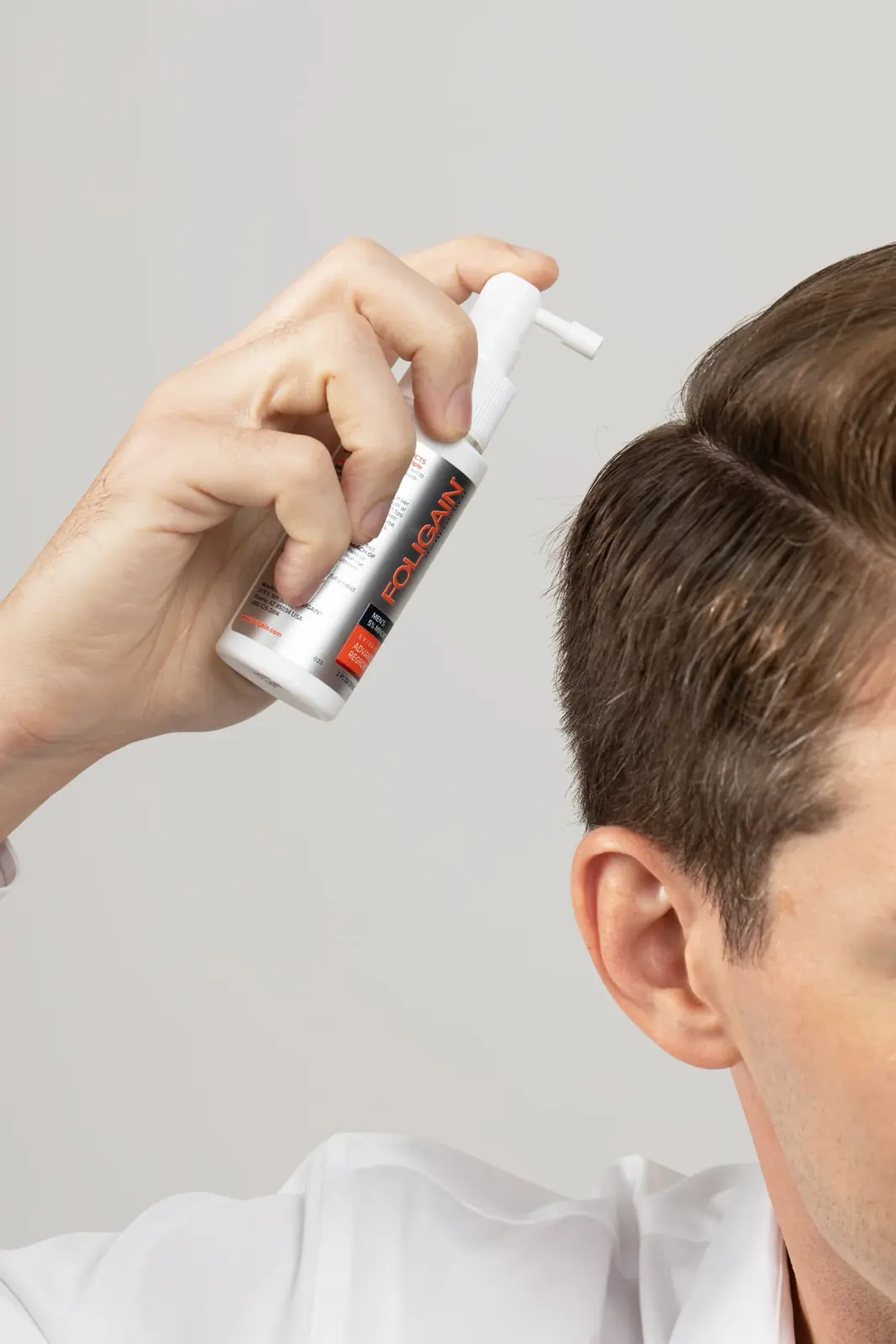
Images are matched to the topic for education; always confirm directions and claims on the exact product label.
Frequently asked questions
How fast does hair grow?
Scalp hair grows roughly 1 cm, or about half an inch, per month during the anagen phase, with individual variation.
Why does my hair stop growing at a certain length?
Maximum length depends on how long your anagen phase lasts. A shorter anagen phase means hair is shed before it grows very long.
Is it normal to shed hair every day?
Yes. Shedding is part of the normal cycle as old hairs are replaced by new ones.
How long before I can judge whether a hair-growth routine is working?
Most dermatologists suggest waiting at least four to six months, and often closer to a year, because new hair needs time to grow long enough to be visible.
Is FOLIGAIN® a drug like Minoxidil?
No. FOLIGAIN® products are cosmetic formulas built around ingredients such as TRIOXIDIL®, not prescription or over-the-counter drugs, so they are positioned differently from Minoxidil or Finasteride.
This content is for educational purposes only and is not medical advice. It is not intended to diagnose, treat, cure or prevent any disease. Speak with a qualified healthcare professional about your individual situation.
Individual results vary. Hair-growth products are used consistently over months, and outcomes depend on the cause and stage of hair loss.
FOLIGAIN® products related to this guide
If this guide matches your situation, our product education pages explain which FOLIGAIN® formats suit which routines.
Explore FOLIGAIN® products