Dutasteride for Hair Loss: Pros and Cons
A stronger DHT blocker used off-label in the US: how it compares with finasteride, evidence and safety.
FOLIGAIN® Editorial Team · 15 min read · Updated 2026-09-28
Medical facts and treatment details have not been independently medically reviewed.
What it is
Dutasteride, sold under the brand name Avodart® and available generically, is approved in the United States for treating an enlarged prostate (benign prostatic hyperplasia). It belongs to the same drug family as finasteride — 5-alpha-reductase inhibitors — but blocks the enzyme more completely, which has made it attractive to some dermatologists as an off-label option for men whose hair loss hasn't responded adequately to finasteride.
In the US, prescribing dutasteride specifically for hair loss is considered off-label use, meaning it isn't the condition the FDA originally approved the drug for, even though a doctor can still legally prescribe it based on clinical judgment. In several other countries, including South Korea and Japan, dutasteride has actually received formal approval for treating male pattern hair loss, and it's sometimes delivered not just as a daily tablet but through scalp mesotherapy, where small amounts are injected directly into the scalp — an approach aimed at concentrating the effect locally.
Because it's a newer and more potent entrant into the hair-loss conversation compared with finasteride's decades of accumulated use, clinicians and patients considering it are generally working with a somewhat thinner body of long-term safety and efficacy data specific to hair, even though the drug itself has a long track record in prostate treatment.
How it works
There are two main types of the 5-alpha-reductase enzyme in the body: type I and type II. Finasteride primarily blocks type II, while dutasteride blocks both type I and type II, which is why it reduces circulating DHT by more than 90 percent in most users — a deeper suppression than finasteride typically achieves.
This broader and stronger blockade is the presumed reason some studies have found somewhat greater hair-density improvements with dutasteride compared with finasteride at commonly studied doses, offering an option for men who've had a partial or disappointing response to finasteride alone. It also means side effects that are hormonally driven have a theoretically higher chance of occurring, and once you stop the medicine, its effects fade much more slowly because dutasteride has a long half-life of around five weeks, compared with roughly a day for finasteride.
Key facts at a glance
| Topic | Summary |
|---|---|
| Status (US) | Rx, off-label for hair loss |
| Half-life | About 5 weeks, much longer than finasteride |
| Blood donation | Typically deferred for a period of months after the last dose |
| Pregnancy | Contraindicated; avoid handling leaking or damaged capsules |
| Delivery methods | Oral tablet, or scalp mesotherapy injections in some clinics |
Pros
- Potentially more effective than finasteride for some men, based on available comparative studies
- Offers an option to discuss when finasteride's response has been limited or disappointing
- Long history of safety data from its use in prostate treatment, even though hair-specific data is thinner
Cons and risks
- Similar sexual side effects to finasteride, and possibly somewhat more frequent given the stronger DHT suppression
- Long washout period means side effects, if they occur, can take months to fully resolve after stopping
- Less long-term, hair-specific safety and efficacy data in the US compared with finasteride, since it isn't officially approved here for this use
- Off-label prescribing means insurance coverage for hair loss indications is uncommon
Who it may suit
Dutasteride tends to come up in conversations with men who have discussed escalating treatment with a dermatologist, often after a meaningful trial of finasteride that didn't deliver the hoped-for result, or in men looking for a potentially stronger option from the outset after weighing the trade-offs.
It is not typically a first-line recommendation given the more limited long-term hair-specific data in the US and the longer-lasting side-effect window, so most clinicians reserve the conversation for patients who understand and accept that trade-off.
Dutasteride vs finasteride: what the comparison really means
Headlines comparing dutasteride to finasteride often report that dutasteride 'wins' on regrowth metrics, and some trials do support that. But a stronger average effect in a study doesn't tell you what will happen for one individual, and it doesn't capture the side-effect side of the ledger, where dutasteride is generally assumed to carry at least the same risks as finasteride and potentially more given deeper hormonal suppression. This is exactly the kind of nuanced, personal risk-benefit conversation that's best had directly with a dermatologist who knows your history, rather than decided from an online forum thread or a study abstract in isolation.
Medical note
This guide is educational and published by FOLIGAIN®, the maker of OTC Minoxidil and cosmetic hair-care products. Prescription treatments and procedures require assessment by a licensed clinician, who can weigh your history, other medicines and goals. Never start, stop or combine prescription medicines without medical advice.
From the FOLIGAIN® library
Related FOLIGAIN® products and routines
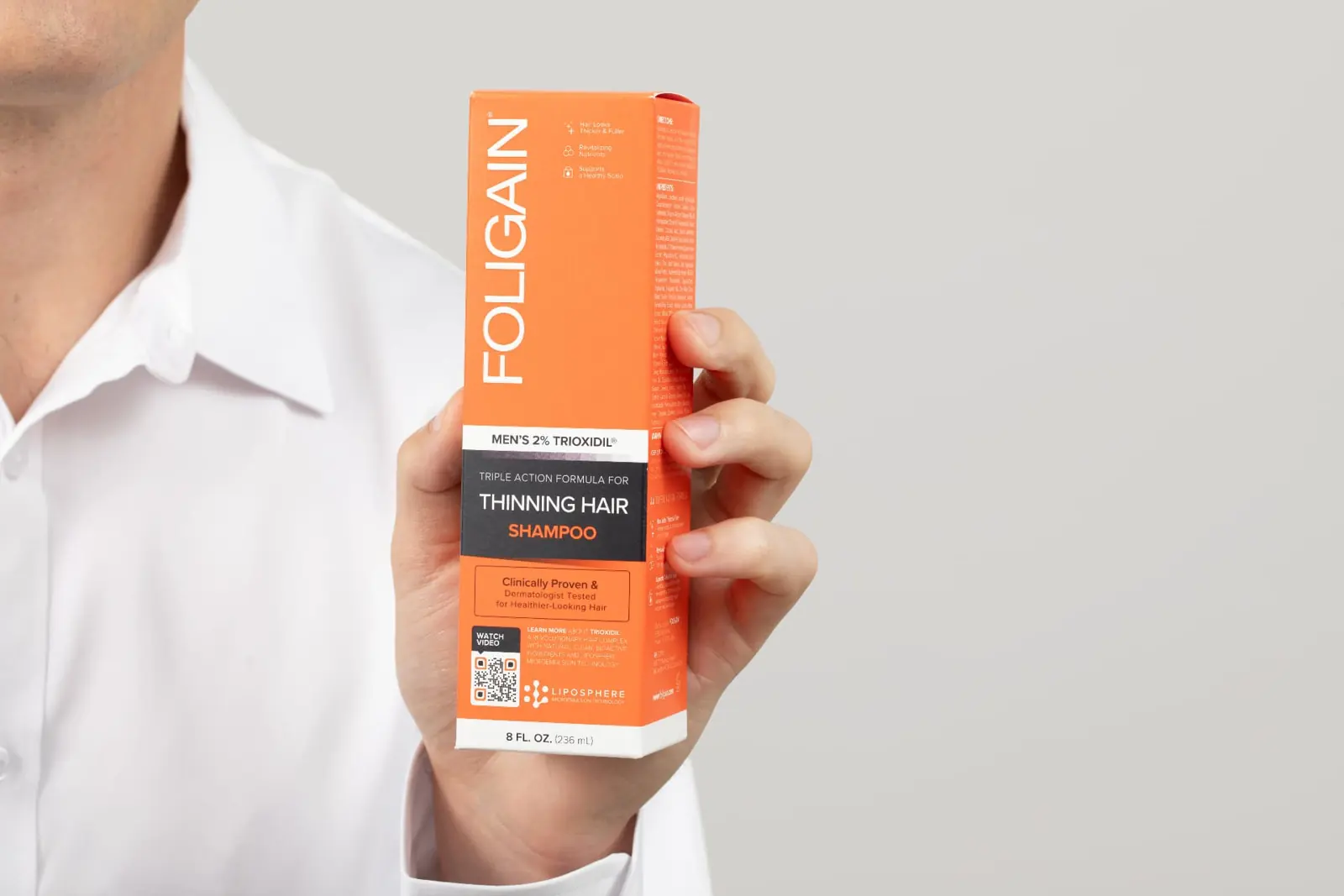
Images are matched to the topic for education; always confirm directions and claims on the exact product label.
Frequently asked questions
Is dutasteride better than finasteride?
It suppresses DHT more completely and some trials show greater regrowth, but it's off-label for hair in the US, has a longer-lasting side-effect window, and has less long-term hair-specific safety data here. Whether it's 'better' for you is a personal, clinical decision.
Can women take dutasteride for hair loss?
It's not typically used in women, and it carries similar pregnancy-related contraindications and warnings against handling damaged capsules as finasteride, if not more stringent given its potency.
How long does dutasteride stay in the body?
Because of its roughly five-week half-life, it can take several months for the drug to fully clear the body, which is why clinicians consider the washout period much longer than with finasteride.
Is scalp mesotherapy with dutasteride safer than the tablet?
The idea behind injecting it into the scalp is to concentrate the effect locally and potentially reduce systemic exposure, but it still isn't a standardized, FDA-approved approach in the US, and evidence is limited. Discuss it carefully with a dermatologist experienced in the technique.
This content is for educational purposes only and is not medical advice. It is not intended to diagnose, treat, cure or prevent any disease. Speak with a qualified healthcare professional about your individual situation.
Individual results vary. Hair-growth products are used consistently over months, and outcomes depend on the cause and stage of hair loss.
FOLIGAIN® products related to this guide
If this guide matches your situation, our product education pages explain which FOLIGAIN® formats suit which routines.
Explore FOLIGAIN® products