Minoxidil 2% vs 5%: Which Strength Is Right for You?
What the two over-the-counter strengths are, who each is labeled for, how they compare in studies, and how to choose between them.
FOLIGAIN® Editorial Team · 19 min read · Updated 2026-09-28
Medical facts and treatment details have not been independently medically reviewed.
What the percentage actually means
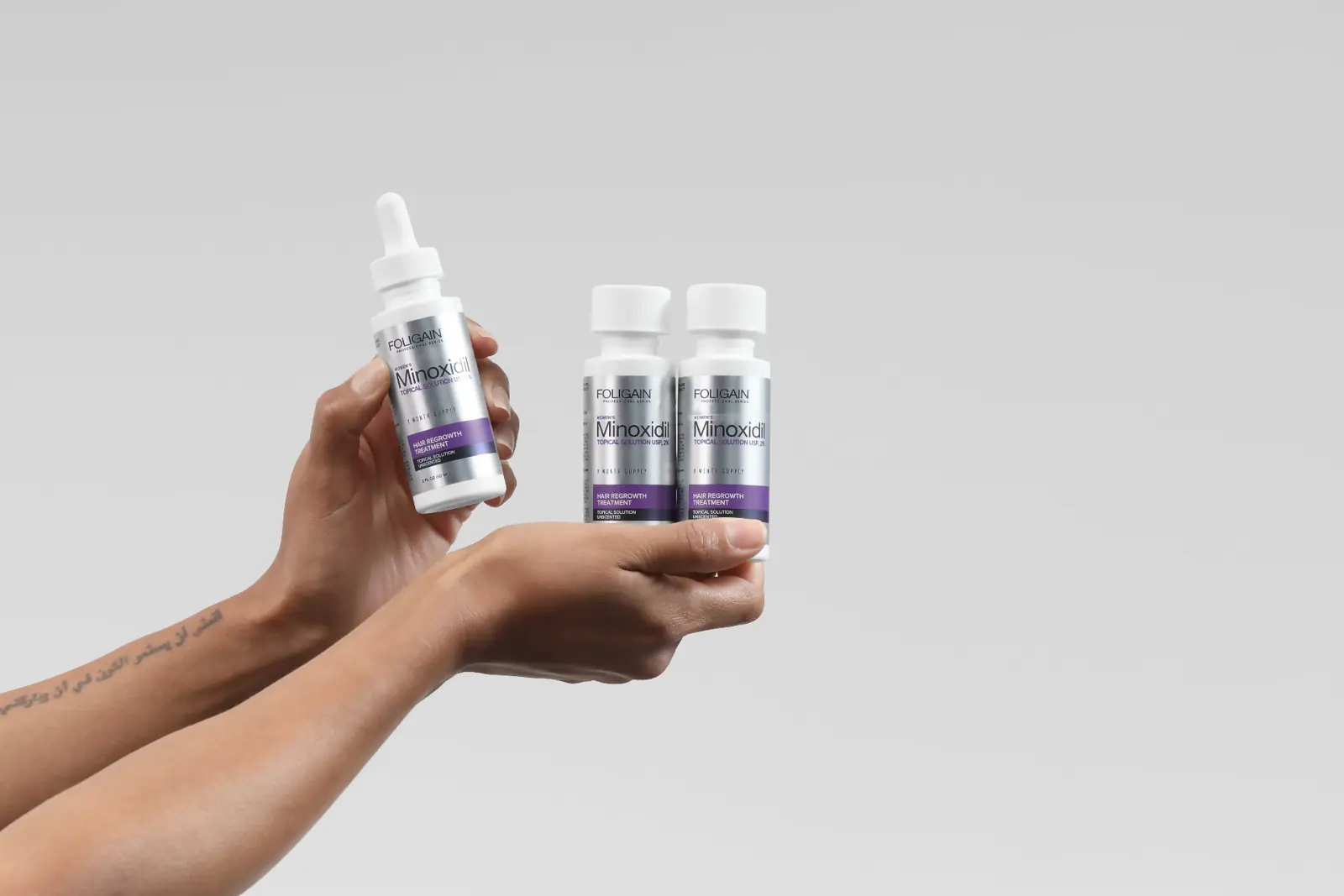
The percentage on a Minoxidil product describes how much Minoxidil is dissolved in the product: 2% means 20 mg per mL, 5% means 50 mg per mL. When you apply the labeled 1 mL dose of solution, you are applying 20 mg or 50 mg of Minoxidil to the scalp. Only a small fraction of that is absorbed through the skin.
The rest of the formula — the vehicle — matters too. Traditional solutions use alcohol, water and propylene glycol to dissolve Minoxidil and help it spread and penetrate. Foams typically avoid propylene glycol, which some people find irritating. The vehicle affects feel, drying time and tolerability, but the percentage defines the dose.
It's worth remembering that a higher number on the label is not automatically a stronger commitment or a faster fix. Minoxidil works gradually regardless of strength, because it acts on the hair growth cycle rather than instantly stimulating visible hair. The strength changes the dose delivered per application, not the biology of how long a follicle takes to complete a cycle.
Understanding the hair loss Minoxidil is meant for
Both strengths of over-the-counter Minoxidil are labeled for androgenetic alopecia — hereditary pattern hair loss. In men this usually shows up as a receding hairline, thinning at the crown, or both. In women it more often appears as a widening part and diffuse thinning across the top of the scalp, without a receding hairline. The underlying process is similar in both sexes: genetically sensitive hair follicles gradually shrink (miniaturize) over years, producing shorter, finer hairs until some follicles stop producing visible hair altogether.
Minoxidil doesn't address the root hormonal or genetic trigger of pattern loss. Instead it works locally on the scalp to prolong the active growth phase of the hair cycle and encourage blood flow to follicles, which can help miniaturized follicles produce thicker hair for longer. That's true whether you use 2% or 5% — the strength affects how much active ingredient reaches the follicle, not the fundamental mechanism.
This matters for choosing a strength because Minoxidil is not labeled for other causes of hair loss, such as alopecia areata, scarring alopecias, thyroid-related shedding or telogen effluvium following illness or stress. If your hair loss looks patchy, comes with scalp pain, redness, scaling, or started suddenly after a major physical or emotional event, a strength decision is the wrong first question — a proper diagnosis is. A dermatologist can confirm whether pattern hair loss is really what's happening before you settle on 2% versus 5%.
Who each strength is labeled for
US labeling differs by strength and format, so the first step is always reading the Drug Facts panel. The general picture for US over-the-counter products is below. Other countries have their own rules, and some markets label strengths differently.
| Product type | Typical US labeling | Typical directions |
|---|---|---|
| 2% solution | Women (and men) | 1 mL twice daily |
| 5% solution | Men only | 1 mL twice daily |
| 5% foam (men) | Men | Half a capful twice daily |
| 5% foam (women) | Women | Half a capful once daily |
What the studies show
The best-known comparison is a 48-week randomized trial in men with pattern hair loss that compared 5% solution, 2% solution and placebo. Men using 5% had more non-vellus hair regrowth than those using 2%, and responded earlier. Both beat placebo. Itching and irritation were somewhat more common with 5%, largely linked to the vehicle.
In women, studies of 2% solution and 5% foam once daily have both shown benefit over placebo. The once-daily 5% foam regimen was developed partly to offer a simpler routine with fewer applications, while keeping propylene glycol out of the formula. Comparative data specifically pitting 2% against 5% in women is more limited than in men, which is part of why labeling for women has historically leaned toward 2% solution or once-daily 5% foam rather than twice-daily 5% solution.
Individual response varies a lot. Some people respond well to 2%, some see little change even on 5%. Genetics, how early you start, the extent of miniaturization and, above all, consistency drive outcomes more than the difference between strengths. A person who uses 2% every single day for a year is likely to do better than someone who uses 5% sporadically for a few weeks and gives up.
It's also worth noting that no study shows either strength reverses long-standing, fully miniaturized hair loss where follicles have stopped producing visible hair altogether. Minoxidil, at either strength, works best on follicles that are still present and cycling, even if thin — which is one reason clinicians often suggest starting sooner rather than later once pattern loss is confirmed.
How long each strength takes to show results
Regardless of strength, Minoxidil follows a similar general timeline because it works on the hair growth cycle rather than acting instantly. In the first two to eight weeks, some people notice a temporary increase in shedding as resting hairs are pushed out to make room for new growth — this can happen with 2% or 5% and is not a sign the product has failed.
Between roughly two and four months, some people begin to see finer, shorter hairs growing in the treated area. The first fair checkpoint for judging whether a strength is working for you is usually around four to six months of consistent, correctly applied use. Many US Drug Facts labels specifically advise stopping and consulting a doctor if there is no growth after four months of twice-daily use.
Between six and twelve months, hairs that responded typically continue to thicken and become more visible. Neither strength speeds up this biological timeline — a 5% product does not produce visible results in half the time of a 2% product. What differs is the eventual degree of regrowth reported in studies, not the pace at which any given follicle completes its cycle.
Side effects by strength
The most common side effects of topical Minoxidil are local: itching, dryness, flaking and redness. Unwanted facial hair growth (hypertrichosis), often on the forehead or cheeks, is more common with higher strength and in women. It usually fades after stopping, but it is a common reason women are directed to 2% or once-daily 5% foam.
Systemic effects such as dizziness, a racing heartbeat, chest pain or swelling of the hands and feet are rare with topical use but mean you should stop and seek medical advice. The label lists these warning signs.
Because 5% delivers more than double the active ingredient of 2% in the same application volume, it makes sense that side effects tracking dose — irritation and facial hair — are somewhat more frequent at the higher strength. This doesn't mean 5% is unsafe when used as labeled; it means the margin for skipping the label's instructions (for example, applying more than directed, or using a men's product off-label) is smaller.
- Irritation: slightly more frequent with 5% solution, often due to propylene glycol
- Facial hair: more frequent with higher strength, especially in women
- Initial shedding: can occur with either strength in the first weeks
FOLIGAIN® and alternatives: comparing strengths across brands
FOLIGAIN® offers OTC topical Minoxidil products, as do Rogaine® and various retailer store brands. When comparing 2% or 5% products across brands, the first checkpoint is always the labeled percentage, format and intended user, since these determine the dose and the directions you should follow. Two 5% solutions from different brands share the same active ingredient and, in principle, a similar dose per application, but vehicle ingredients, drying time, scent and packaging can differ and affect how comfortable a routine is to maintain.
FOLIGAIN® also markets TRIOXIDIL®, a cosmetic hair-care ingredient complex used in some FOLIGAIN® shampoos and serums. TRIOXIDIL® is a cosmetic complex, not an OTC Minoxidil drug and not a substitute for it — it isn't reviewed or labeled the same way as a Drug Facts product, and its role is to support a hair-care routine rather than replace a clinically studied treatment. If you're deciding between 2% and 5% Minoxidil, that decision is separate from whether you also use a cosmetic shampoo or serum alongside it.
Beyond OTC strength choices, other paths exist for people who don't respond to, or aren't eligible for, topical Minoxidil: prescription finasteride for men, prescription spironolactone for some women, clinician-supervised low-dose oral Minoxidil, and procedural options like hair transplantation. These require a clinician's evaluation of eligibility, risk and expected timeline, and are not something to combine with OTC products without medical guidance.
How to choose
Start with the label that fits you. Men usually choose 5% solution or foam. Women usually choose 2% solution twice daily or 5% foam once daily. If you have a sensitive scalp or reacted to a solution before, a foam or a lower-alcohol formula may be easier to live with.
Then think about routine. A product that you use every day for a year will do more than a stronger product used inconsistently. If twice-daily application is unrealistic, a once-daily labeled option can be a better practical choice.
If you have heart conditions, low blood pressure, scalp disease or are pregnant or breastfeeding, talk to a clinician first. And if you're unsure whether your hair loss is even the type Minoxidil addresses, that conversation is worth having before you buy either strength — it can save months of guessing.
Cost, availability and long-term commitment
Because pattern hair loss is a lifelong genetic tendency and Minoxidil only works while you keep using it, cost and convenience over years matter as much as strength. Larger multi-month packs of either 2% or 5% can lower the per-month cost, but check expiry dates before buying a big supply, and make sure storage directions (many solutions and foams have specific temperature guidance) are practical for your home.
Availability also differs: 5% solution and foam for men are widely stocked, 2% solution remains available though sometimes harder to find on shelves than 5%, and foam formats can cost more per month than solutions of the same strength. None of these logistics change the underlying biology, but they do affect whether you'll realistically keep using a product for the year or more it typically takes to judge long-term benefit, and for as long as you want to maintain any gains afterward.
If cost or access is a barrier to using the labeled strength that fits you, discuss it with a pharmacist rather than choosing an off-label strength or an inconsistent schedule purely to save money — an inconsistent routine tends to produce worse results than a modest, steady one.
Reassessing your strength choice over time
A strength decision made at the start of treatment doesn't have to be permanent. Some people begin on 2% because it was the strength labeled for them, then discuss moving to a 5% foam labeled for their sex once they understand how their scalp tolerates topical Minoxidil generally. Others start on 5% and step down to 2% or a once-daily format if side effects are bothersome and they're eligible for a lower-strength or once-daily labeled product.
Any change in strength or format is really a fresh start for the purposes of judging results: give the new product its own four-to-six-month runway rather than assuming your prior months of use on a different strength count toward the new one. Keep your baseline and monthly photos so you have a consistent record to compare against, no matter how many times you adjust the product itself.
If you reach a point where you've fairly trialed the strength that matches your label, used it consistently, and still see no benefit, that's the moment to talk to a clinician about other treatment paths rather than continuing to experiment with OTC strengths indefinitely.
Causes behind the thinning both strengths target
Androgenetic alopecia is driven by a genetic sensitivity in certain scalp follicles to hormones, which gradually shortens each hair's growth phase and shrinks the follicle over repeated cycles. This happens slowly, often over years, and family history is one of the strongest predictors of who develops it and how early. Neither 2% nor 5% Minoxidil changes this underlying genetic sensitivity — both work downstream, on the follicle's growth cycle, which is why realistic expectations and consistent use matter more than the number on the bottle.
Because the cause is chronic, ongoing treatment is generally needed to maintain any benefit at either strength. This is different from a course of antibiotics that cures an infection; Minoxidil is closer to a daily maintenance habit for as long as you want to keep the results it helps you achieve.
Lifestyle habits that shape how well either strength performs
Strength is only one input into how someone responds to topical Minoxidil. Sleep, stress and overall health don't replace consistent application, but chronic sleep deprivation and prolonged high stress are both associated with a body-wide tendency toward more hair shedding, which can make it harder to judge whether a strength is 'working' if an unrelated stressor is adding extra shedding on top of pattern loss. Getting a general sense of your baseline stress and sleep levels before starting can help you interpret changes more fairly.
Smoking and very restrictive diets are sometimes discussed as factors that may affect scalp circulation or nutrient supply to follicles, though the evidence connecting them specifically to Minoxidil's effectiveness is limited rather than well established — this is a reasonable area to mention to a clinician rather than a proven lever to pull for better results. Similarly, scalp massage and gentle exfoliation are popular self-care habits that some people add alongside Minoxidil; they may support a comfortable routine, but they aren't a substitute for the labeled strength and frequency, and there isn't strong evidence they change how much a given strength regrows.
The most controllable factor by far remains simple adherence: applying the labeled amount, at the labeled frequency, for the number of months needed to judge a fair result. People sometimes look for a lifestyle change or a higher strength to compensate for inconsistent use, when the more reliable fix is usually just tightening up the daily routine first.
The label comes first
Always follow the Drug Facts label of the exact product you use. This guide is educational and does not replace advice from a pharmacist or clinician.
From the FOLIGAIN® library
Related FOLIGAIN® products and routines
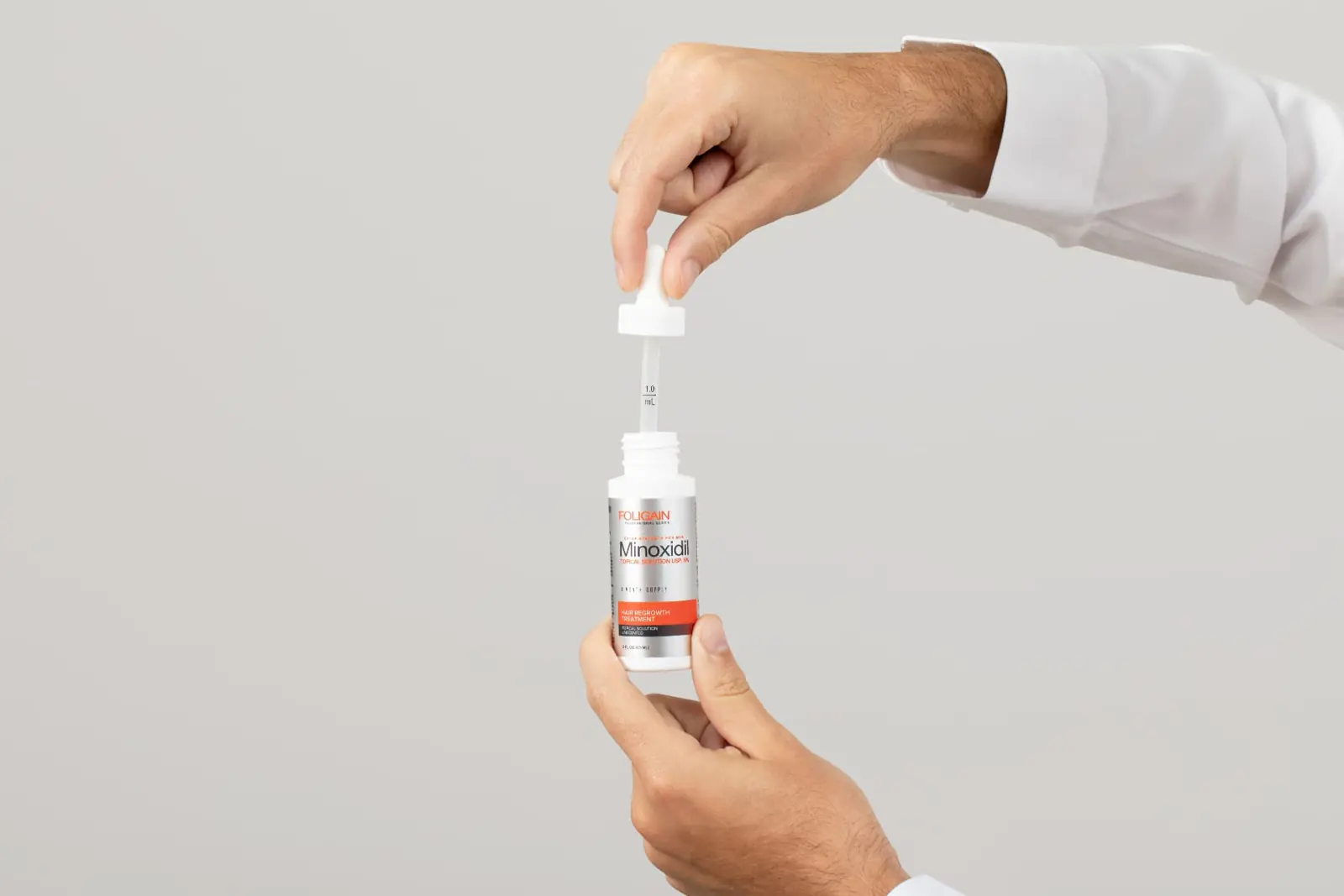
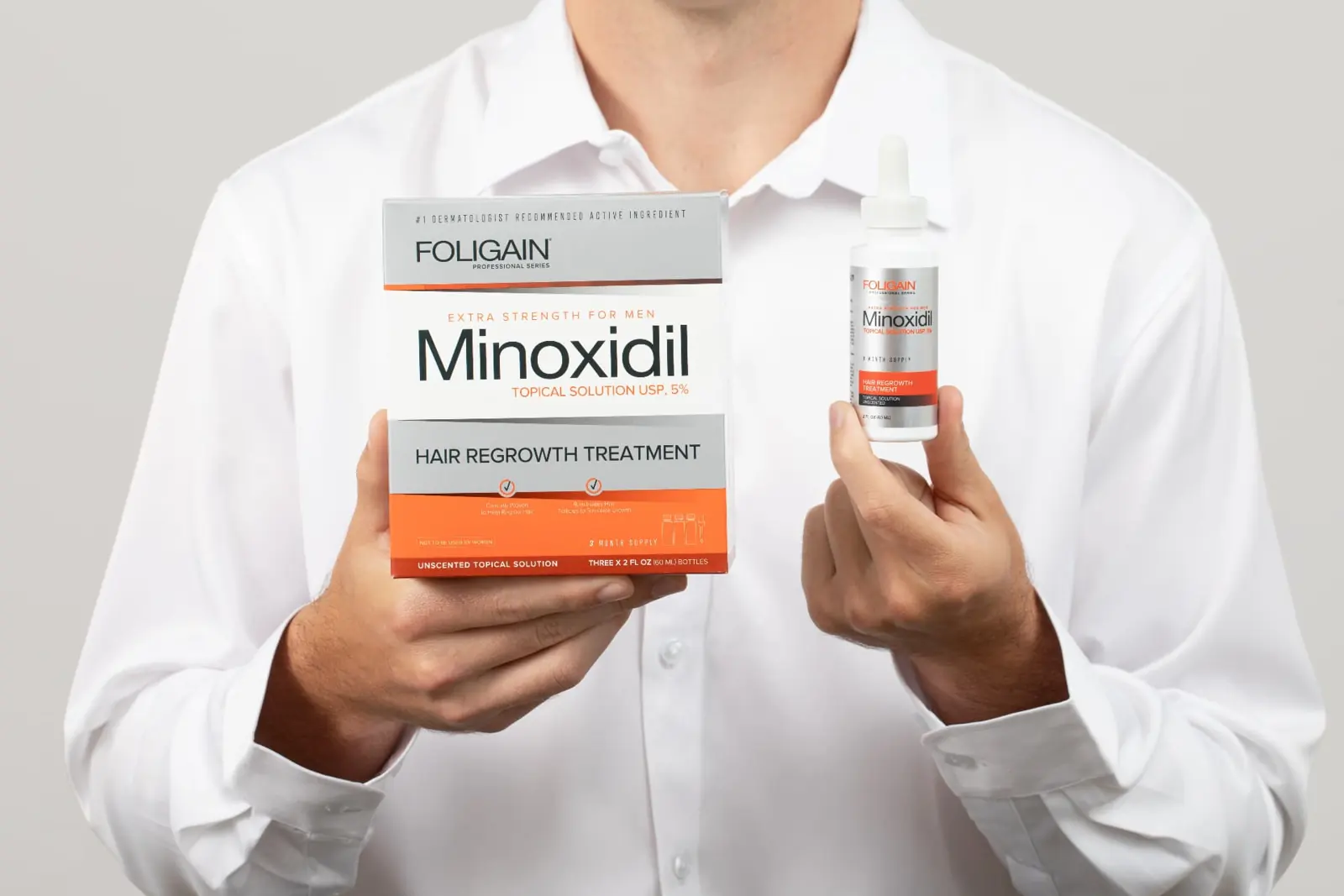
Images are matched to the topic for education; always confirm directions and claims on the exact product label.
Frequently asked questions
Is 5% twice as effective as 2%?
No. In studies 5% produced more regrowth in men than 2%, but not twice as much, and individual results vary widely.
Can women use 5%?
In the US, 5% foam is labeled for women once daily. 5% solution is labeled for men only. Follow your product's label or ask a clinician.
Should I switch from 2% to 5% if I see no results?
Give any strength at least 4 to 6 months of consistent use first. If you're eligible for 5% under its label, discussing a switch with a pharmacist is reasonable.
Does a higher strength cause more shedding?
Early shedding can happen with either strength. It reflects follicles entering a new growth cycle and usually settles within weeks.
Will a stronger product work faster?
No. Both strengths work on the same hair growth cycle, which takes months regardless of dose. Strength may affect the eventual degree of regrowth, not the speed of the timeline.
Can I use a FOLIGAIN® cosmetic product instead of choosing a strength?
No. TRIOXIDIL® is a FOLIGAIN® cosmetic ingredient complex, not an OTC Minoxidil drug, and it isn't a substitute for choosing and using a labeled Minoxidil strength if that's the treatment you and your clinician decide on.
Does stress or poor sleep affect which strength I should pick?
No — strength should still match your label. But ongoing stress or poor sleep can add extra shedding on top of pattern loss, which can make it harder to judge whether a strength is working, so it's worth mentioning to a clinician if shedding seems unusually heavy.
Can smoking or diet change how well a strength works?
The evidence connecting smoking or restrictive diets specifically to Minoxidil's effectiveness is limited, so it's reasonable to raise general health habits with a clinician rather than treat them as a proven way to boost results.
Does the strength I choose affect how long I need to keep using it?
No. Whichever labeled strength fits you, benefit depends on ongoing, consistent use for as long as you want to keep any results — strength doesn't change that basic maintenance requirement.
This content is for educational purposes only and is not medical advice. It is not intended to diagnose, treat, cure or prevent any disease. Speak with a qualified healthcare professional about your individual situation.
Individual results vary. Hair-growth products are used consistently over months, and outcomes depend on the cause and stage of hair loss.
FOLIGAIN® products related to this guide
If this guide matches your situation, our product education pages explain which FOLIGAIN® formats suit which routines.
Explore FOLIGAIN® products