Minoxidil Results Timeline: What to Expect Month by Month
A realistic month-by-month picture of the first year on topical Minoxidil, from early shedding to the point where you can judge results.
FOLIGAIN® Editorial Team · 11 min read · Updated 2026-09-28
Medical facts and treatment details have not been independently medically reviewed.
Why Minoxidil is slow
Hair grows roughly 1 cm per month, and Minoxidil works by influencing the hair cycle: lengthening the growth (anagen) phase and gradually enlarging miniaturized follicles. Every hair has to complete a cycle before the change shows. That's why every label asks for patience measured in months, not weeks.
Month by month
| Period | What commonly happens | What to do |
|---|---|---|
| Weeks 0–2 | Nothing visible | Build the routine and take baseline photos |
| Weeks 2–8 | Possible increase in shedding | Keep going; it usually settles |
| Months 2–4 | Fine, soft new hairs may appear | Stay consistent; compare photos monthly |
| Months 4–6 | First visible density change for responders | First fair assessment |
| Months 6–12 | Hairs thicken and darken | Continue; reassess at 12 months |
| 12 months + | Results stabilize with continued use | Maintain the routine |
How to track progress honestly
Memory is unreliable and daily mirror checks distort perception. Take photos in the same place, lighting, angle and hair state (dry, unstyled) once a month. Photograph the crown and part line from above and the hairline from the front.
- Same room and light source
- Same camera distance
- Hair dry and combed the same way
- Compare month 0 with month 4, 6 and 12, not week to week
What counts as success
For many people, success is slowing or stopping further thinning rather than dramatic regrowth. Maintaining density you would otherwise have lost is a real result. Regrowth tends to be better at the crown and mid-scalp than at a receded hairline.
If there's no benefit after about 4 months (label guidance for many US products), stop and consult a clinician about other options.
Before the clock starts: make sure the cause fits
The timeline above describes people using topical Minoxidil for hereditary pattern thinning. Pattern loss usually develops gradually: a widening part or diffuse thinning over the central scalp in women; recession, crown thinning or both in men. It is easy to mistake a temporary surge of shedding for the same problem. A major illness, high fever, surgery, childbirth, rapid weight change or severe stress can shift many hairs into the resting phase at once. The resulting telogen effluvium may begin months after the trigger and often improves once the underlying issue resolves. Minoxidil is not a substitute for identifying and managing that trigger.
Round patches, broken hairs, redness, scarring, severe scale or pain raise different possibilities, including alopecia areata, infection, inflammatory scalp disease or traction. A change in medication or a nutritional deficiency may also contribute. Two causes can coexist; pattern loss can become more obvious after a shedding episode. If the pattern is unclear, a dermatologist can examine the scalp, ask about the timing and decide whether any tests are warranted. The most useful first step is not buying the strongest bottle; it is understanding what you are trying to change.
The first eight weeks: routine before results
Photograph your scalp before starting in consistent lighting and with dry, similarly styled hair. Decide when you will apply the product, where you will store it and how you will keep it away from children and pets. Read the entire Drug Facts panel on the specific package. The labeled amount and frequency depend on whether it is a men's solution, a men's foam, a women's solution or a women's foam. More product does not speed up growth and may increase irritation or unwanted transfer to other skin.
In the first month, most people see no improvement. Some notice a brief increase in shedding as follicles transition between phases, but not everyone does. Do not treat shedding as proof that treatment is working or proof that it is failing. Notice how your scalp feels: dryness, itch, redness or flaking may be caused by the vehicle or by an unrelated scalp condition. If the reaction is severe, persistent or accompanied by pain or broken skin, stop and ask a clinician. Chest pain, rapid heartbeat, dizziness, swelling or sudden weight gain call for prompt medical advice under topical Minoxidil warnings.
Consistency is the controllable part of this stage. Put the topical on the scalp rather than only the hair shafts, wash your hands afterward and let it dry before lying on pillows or letting a pet contact your hair. Missing one application does not erase months of use; do not double the next dose. If your routine is impossible to maintain, talk to a pharmacist about a labeled format that fits your life rather than repeatedly restarting the clock.
Months two to six: interpret changes cautiously
Early short hairs may appear near the treated area, but photographs are more reliable than memory. A haircut, wet hair, sunlight from a different direction or moving a part can make the same density appear very different. Compare monthly photographs taken from the same angle. In some people, slowing of further loss is the meaningful outcome even when new growth is modest. Results vary by person and by the location and duration of thinning; a deeply receded hairline may not respond like a recently thinned crown.
Many U.S. Drug Facts labels advise stopping and consulting a doctor if there is no hair growth after four months. That does not mean everyone must see a dramatic visible result on day 120. If you cannot tell whether there has been a change, bring your baseline photos, exact package and application history to a clinician or pharmacist. They can reassess the diagnosis, whether you used the labeled regimen, and whether another scalp condition is getting in the way. A clinician may discuss prescription treatment for appropriate patients; do not add oral or compounded medicines to a routine without medical supervision.
Months six to twelve and maintenance
For a person who responds, hairs may become more visible over the first year. There is no universal schedule or guaranteed amount of regrowth. Compare your month-six and month-twelve photos with baseline rather than expecting continuous improvement every week. Hair length affects perceived coverage, so distinguish longer existing hair from new density. If the loss continues quickly despite consistent use, or changes into a patchy or inflamed pattern, do not simply wait for the next milestone: seek a clinical assessment.
Topical Minoxidil is a maintenance treatment, not a permanent reset of hereditary follicle sensitivity. If you stop, hair gained or maintained with treatment is generally lost over the following months. That makes convenience, scalp tolerance and cost per month important in a long-term decision. A six-month pack may lower the per-month cost but does not change how the active works; check the expiry date and storage directions before purchasing a large supply. If you decide to stop, speak with a clinician if you are unsure whether changes reflect the original condition, a new cause or the loss of treatment benefit.
FOLIGAIN® and alternatives: compare like with like
FOLIGAIN® sells labeled OTC topical Minoxidil, as do Rogaine® and several retailer labels. If you compare two products, start with the same intended user, concentration, format and labeled application schedule; then compare vehicle ingredients, packaging, availability and cost per month. Same-strength topical Minoxidil products share the same active ingredient, but this alone does not prove identical feel or head-to-head outcomes. Some people prefer foam because of its texture or because it often omits propylene glycol; others prefer a dropper to target a precise area. Read each package because formulations and labels can change.
FOLIGAIN® also offers TRIOXIDIL® cosmetic hair care. It is a FOLIGAIN® cosmetic complex, not an OTC Minoxidil drug active. A shampoo or serum can support a pleasant routine and the appearance of hair, but it should not be presented as a substitute for the evidence and label of a drug. Prescription finasteride, prescription spironolactone, clinician-directed oral Minoxidil, procedures and transplants are different options for different diagnoses and people. They require their own conversations about eligibility, risks, expected timelines and cost. No single brand is the right choice for everyone; choose the approach you can follow safely and realistically after you know the cause.
Sources and a note on uncertainty
For directions and stopping rules, consult the current U.S. Drug Facts label of your exact topical Minoxidil product through its package or the National Library of Medicine's DailyMed label search (dailymed.nlm.nih.gov). For the broader distinction between patterned thinning and other causes of loss, see the American Academy of Dermatology's public hair-loss guidance (aad.org/public/diseases/hair-loss). Timelines here are general guideposts, not a prediction for an individual. This material has not been independently medically reviewed and is not personal medical advice.
Safety reminder
Always follow the Drug Facts label of the exact product you use. This guide is educational and does not replace advice from a pharmacist or clinician.
From the FOLIGAIN® library
Related FOLIGAIN® products and routines
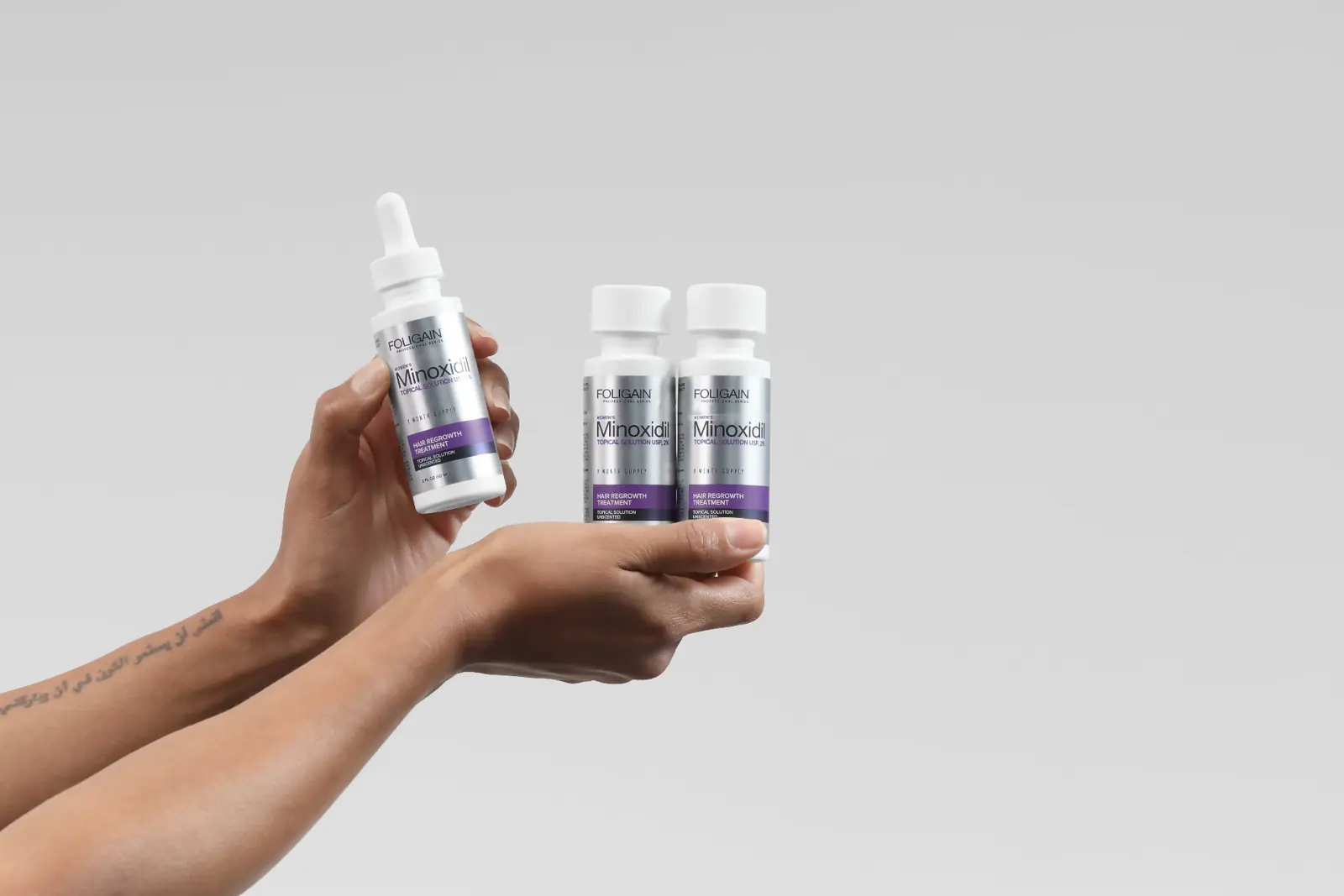
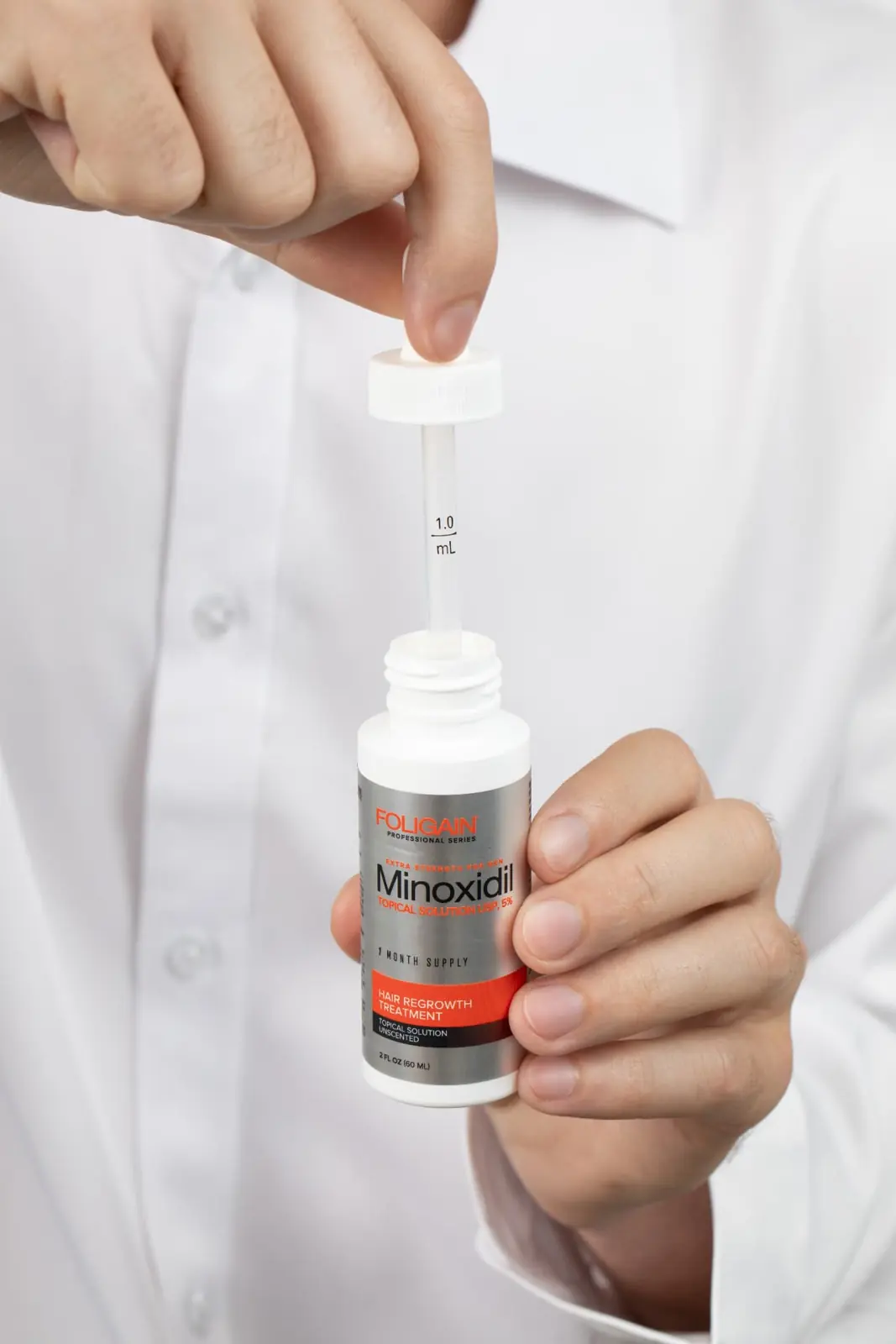
Images are matched to the topic for education; always confirm directions and claims on the exact product label.
Frequently asked questions
Is shedding a good sign?
Early shedding often means follicles are entering a new growth cycle. It's temporary. Shedding that persists beyond ~2–3 months deserves a clinician's view.
When should I give up?
Many US labels say to stop and consult a doctor if there's no regrowth after 4 months. Some clinicians suggest assessing at 6 months.
Will results disappear if I stop?
Yes, gradually. Hair gained or maintained through Minoxidil tends to be lost over a few months after stopping.
This content is for educational purposes only and is not medical advice. It is not intended to diagnose, treat, cure or prevent any disease. Speak with a qualified healthcare professional about your individual situation.
Individual results vary. Hair-growth products are used consistently over months, and outcomes depend on the cause and stage of hair loss.
FOLIGAIN® products related to this guide
If this guide matches your situation, our product education pages explain which FOLIGAIN® formats suit which routines.
Explore FOLIGAIN® products