The Hair Growth Cycle Explained: Anagen, Catagen, Telogen and Exogen
Understanding the four phases of hair growth is the key to understanding shedding, timelines and why every hair-growth routine takes months.
FOLIGAIN Editorial Team · 12 min read · Updated 2026-09-28

Why the cycle matters
Almost every question about hair loss comes back to the hair cycle. Why does shedding increase when starting Minoxidil? Why does stress-related shedding appear months later? Why do you need to wait six months to judge a product? Why doesn't hair just keep growing forever? Each answer depends on how follicles move through their phases.
The average adult scalp has around 100,000 follicles. Each one is a small organ that repeatedly builds a hair, rests and starts again. Unlike some animals, humans shed asynchronously: neighbouring follicles are at different stages, so we don't moult all at once.
Phase 1: Anagen (growth)
Anagen is the active growth phase. Cells at the base of the follicle divide rapidly, building the hair shaft and pushing it upward. On the scalp, anagen normally lasts from about two to seven years, and at any time around 85-90% of scalp hairs are in this phase.
The length of anagen largely determines how long your hair can grow. Someone with a long anagen phase can grow hair to waist length. Someone with a shorter phase may find hair seems to stop at shoulder length. Eyebrows and body hair have much shorter anagen phases, which is why they stay short.
Phase 2: Catagen (transition)
Catagen is a brief transition lasting around two to three weeks. Growth stops, the lower part of the follicle shrinks and the hair detaches from its blood supply, forming a club hair. Only about 1-2% of scalp hairs are in catagen at any time.
Phase 3: Telogen (rest)
Telogen is the resting phase, lasting about three months. The club hair stays in the follicle while the follicle prepares to begin a new anagen phase. Around 10-15% of scalp hairs are normally in telogen. When larger numbers are pushed into telogen together, as in telogen effluvium, noticeable shedding follows a few months later.
Phase 4: Exogen (shedding)
Exogen is sometimes described separately: the active release of the old club hair, often as a new anagen hair begins to grow beneath it. This is the hair you find in the brush or the drain. Everyday shedding is simply exogen happening across thousands of follicles at different times.
The cycle at a glance
| Phase | Duration (scalp) | Share of hairs | What happens |
|---|---|---|---|
| Anagen | 2-7 years | ~85-90% | Active growth, about 1 cm per month |
| Catagen | 2-3 weeks | ~1-2% | Growth stops; follicle regresses |
| Telogen | ~3 months | ~10-15% | Resting club hair; new cycle prepares |
| Exogen | Part of late telogen | Varies | Old hair is released and shed |
What goes wrong in pattern hair loss
In androgenetic alopecia, susceptible follicles respond to DHT with a progressively shorter anagen phase. Each new hair has less time to grow, so it ends up shorter. At the same time the follicle itself shrinks (miniaturization), producing a finer, lighter hair. The telogen phase can also lengthen, and the gap between shedding and regrowth can widen.
The overall effect, repeated over many cycles, is fewer long thick hairs and more short fine ones, which looks like thinning even before any area becomes bald.
How Minoxidil interacts with the cycle
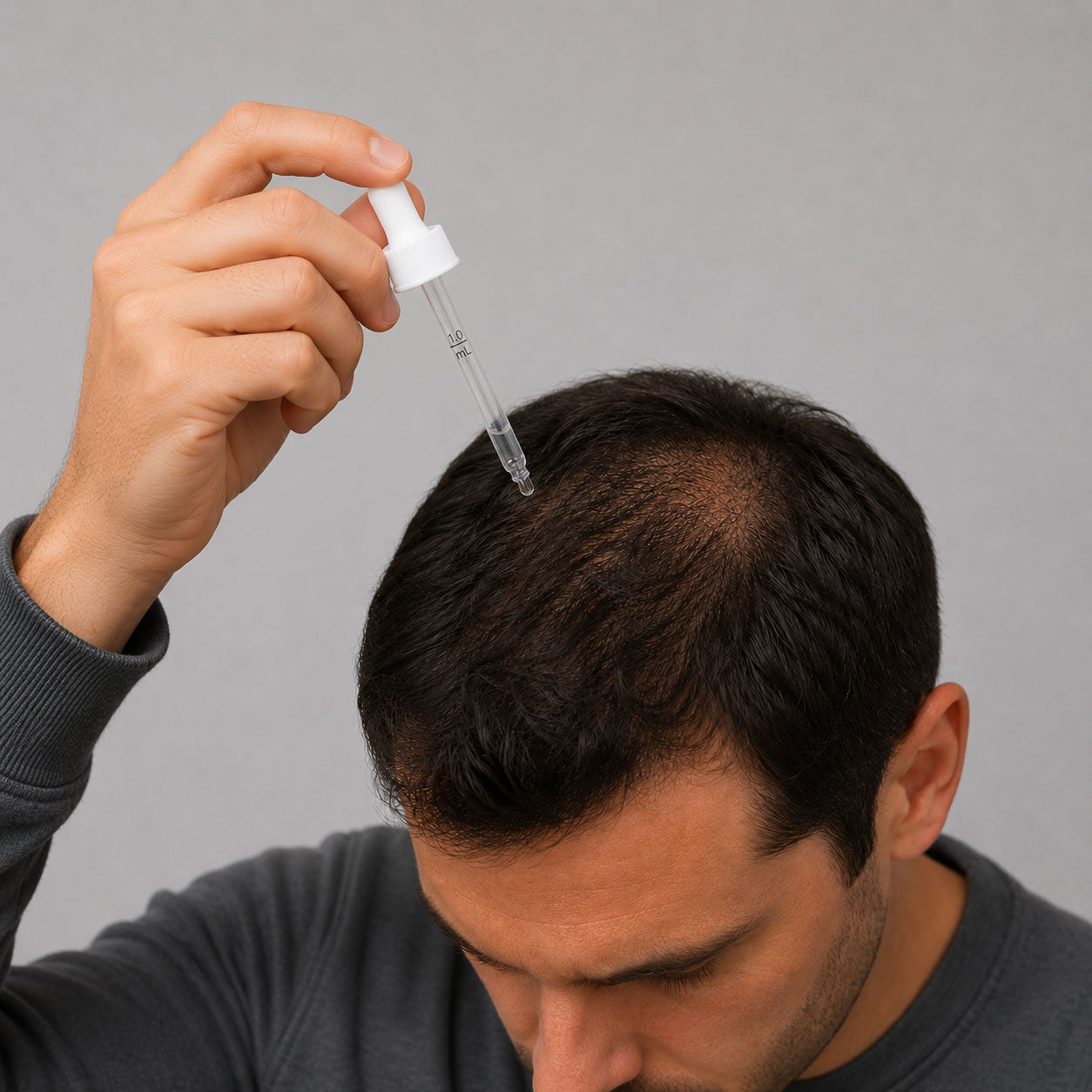
Topical Minoxidil is understood to shorten telogen, prompting resting follicles back into anagen sooner, and to prolong anagen while increasing follicle size. The first effect explains early shedding: resting hairs are released as new ones start to grow. The second explains why improvements, when they occur, take months to become visible: new hairs have to grow long enough to change how the scalp looks.
Seasonal shedding
Some studies have found seasonal variation in shedding, with many people noticing slightly more hair loss in late summer and autumn. This is a normal variation and is usually mild and temporary. It is worth keeping in mind when comparing photos taken in different seasons.
What this means for your routine
- Allow at least one full cycle of new growth (roughly 4-6 months) before judging any change
- Expect some shedding when starting a routine that affects the cycle
- Take photos in the same season where possible for fair comparisons
- Don't stop and restart repeatedly; each restart resets the clock
- Focus on density and hair thickness over time rather than daily hair counts
Frequently asked questions
How fast does hair grow?
Scalp hair grows roughly 1 cm, or about half an inch, per month during the anagen phase, with individual variation.
Why does my hair stop growing at a certain length?
Maximum length depends on how long your anagen phase lasts. A shorter anagen phase means hair is shed before it grows very long.
Is it normal to shed hair every day?
Yes. Shedding is part of the normal cycle as old hairs are replaced by new ones.
This content is for educational purposes only and is not medical advice. It is not intended to diagnose, treat, cure or prevent any disease. Speak with a qualified healthcare professional about your individual situation.
Individual results vary. Hair-growth products are used consistently over months, and outcomes depend on the cause and stage of hair loss.
FOLIGAIN products related to this guide
If this guide matches your situation, our product education pages explain which FOLIGAIN formats suit which routines.
Explore FOLIGAIN products